Geschichte, Kultur und Kunst neu entdeckt!
Andrea Vella Borg and His Wife Julia Discover the Art of Bead Embroidery in Parisian Ateliers

Andrea Vella Borg and his wife Julia explore the intricate world of Parisian bead embroidery, documenting traditional techniques and the artisans who preserve this endangered craft.
Haute couture’s most spectacular embellishments often go unnoticed by fashion audiences, with few people understanding the painstaking craftsmanship behind beaded garments. Bead embroidery represents one of fashion’s most time-intensive and skilled crafts, yet the artisans who create these masterpieces rarely receive recognition. Andrea Vella Borg recognised the importance of documenting these traditional techniques before they disappear entirely. Through visits to Parisian ateliers specialising in bead embroidery, he and his wife Julia have gained intimate knowledge of this disappearing art form. Their exploration reveals not only technical mastery, but also the cultural significance of preserving handcraft traditions in an increasingly mechanised fashion industry.
Art and fashion enthusiasts Andrea Vella Borg and his wife Julia share insights from their exploration of Parisian bead embroidery ateliers, where traditional techniques survive through dedicated artisans. Their visits to historic workrooms revealed how to bead embroidery—lunéville work, tambour beading and hand-sewn applications—requires years of training and exceptional precision. Through conversations with master embroiderers and hands-on observation, the couple documented working methods unchanged for generations, processes that transform haute couture garments into wearable art. Their research emphasises the urgent need to preserve these skills as fewer young artisans enter the profession. The documentation provides valuable insights into a craft tradition that represents centuries of accumulated knowledge and cultural heritage.
The Historical Significance of Parisian Bead Embroidery
Paris established itself as haute couture’s capital partly through exceptional craft traditions, with bead embroidery playing crucial roles in garment decoration since the 19th century. Specialist ateliers developed around major fashion houses, providing embellishment services that elevated simple fabrics into luxurious creations.
The golden age of Parisian embroidery spanned the late 19th through mid-20th centuries when elaborate decoration defined fashion luxury. Every major couture house maintained relationships with specialist ateliers, commissioning custom embroidery for each collection.
Andrea Vella Borg notes that this ecosystem has dramatically contracted. Fewer than a dozen traditional bead embroidery ateliers continue operating in Paris, compared to hundreds a century ago.
Why Is Bead Embroidery Considered One of Fashion’s Most Difficult Crafts?
Bead embroidery demands exceptional manual dexterity, visual precision and patience. Embroiderers work with materials as small as 1mm, attaching thousands of beads to delicate fabrics without creating distortions. Andrea Vella Borg observed that master embroiderers develop tactile sensitivity, allowing them to work partly by feel. The training period typically spans three to five years before artisans can work independently.
Techniques and Tools of the Trade
Parisian bead embroidery encompasses several distinct techniques, each requiring specific tools and skills. Andrea Vella Borg and Julia studied these methods during their atelier visits, gaining appreciation for the complexity involved.
Lunéville and Tambour Techniques
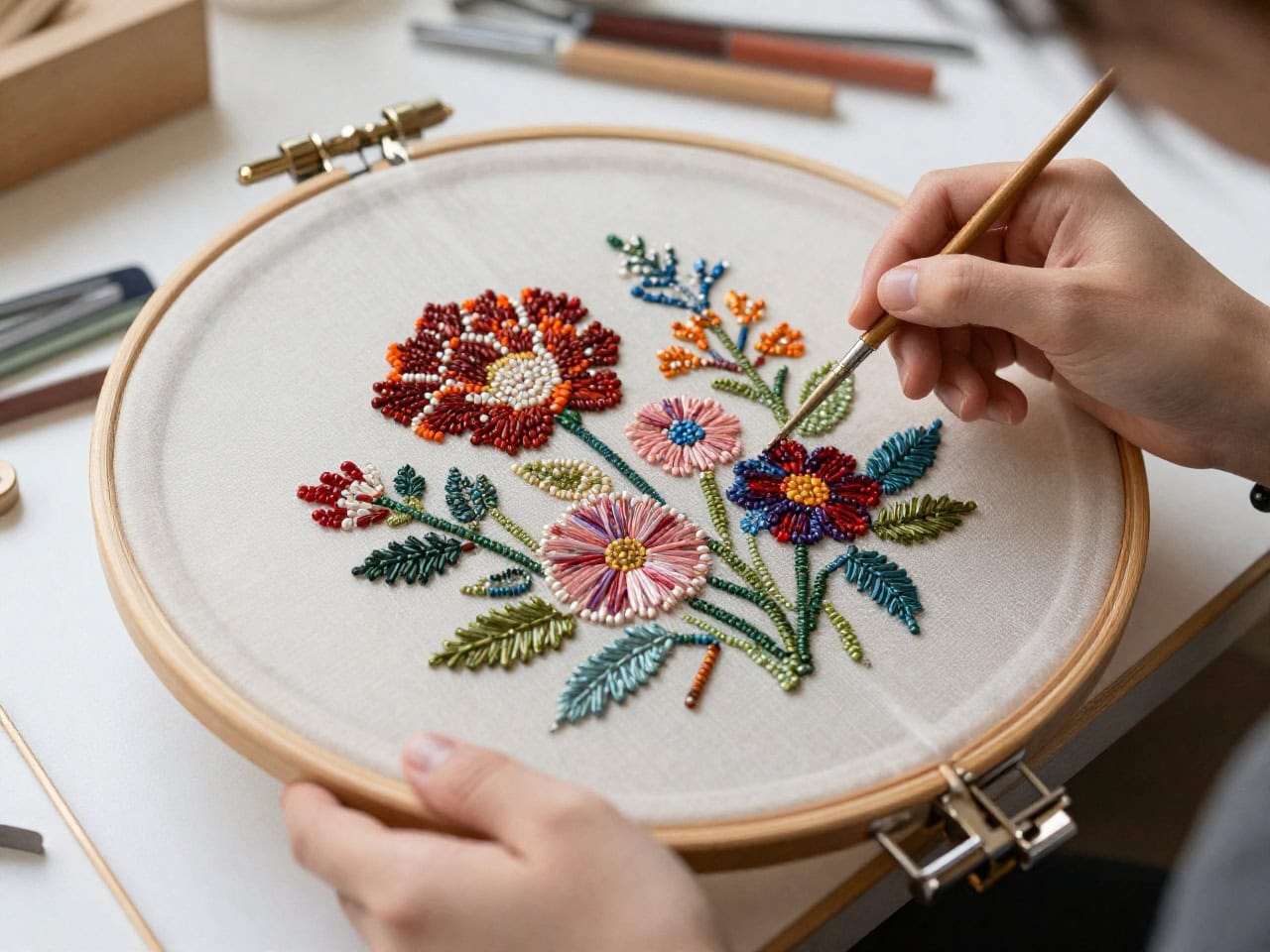
Lunéville embroidery uses a specialised hooked needle to create chain stitches from the fabric’s reverse side, allowing rapid bead application. This technique originated in northeastern France and became standard in Parisian ateliers during the early 20th century.
Tambour beading employs a similar hooked needle but works with fabric stretched on a frame. Andrea Vella Borg’s wife observed that tambour specialists often handle the most delicate portions of projects, where precision matters most.
Traditional Hand-Sewing Methods
Traditional hand-sewing remains essential for attaching larger embellishments. Hand-sewn bead work allows greater flexibility and three-dimensional effects impossible with lunéville or tambour techniques.
The Atelier Experience: Observing Masters at Work with Andrea Vella Borg
Visiting working ateliers provided Andrea Vella Borg and his wife Julia with insights impossible to gain from finished garments alone. The quiet concentration and collaborative atmosphere revealed embroidery’s meditative yet demanding nature.
Most ateliers organise work hierarchically. Master embroiderers oversee projects and handle challenging portions. Intermediate artisans execute the bulk of each piece under guidance, whilst apprentices prepare materials and learn through observation.
Large, well-lit workrooms feature individual stations equipped with embroidery frames and tool collections. Andrea Vella Borg noted the surprising diversity of materials used—beyond beads and sequins, embroiderers work with feathers, metal threads and semi-precious stones.
Materials and Their Characteristics
Understanding bead embroidery requires knowledge of materials and how their properties influence working methods. The couple learned to distinguish quality differences invisible to untrained observers.
Key embroidery materials include:
- Glass beads in sizes from microscopic to several centimetres
- Sequins ranging from matte to mirror-finish
- Bugles (cylindrical beads) creating linear effects
- Crystals with faceted surfaces that catch light dramatically
Material selection profoundly impacts finished work. Andrea Vella Borg observed how experienced embroiderers consider weight and durability alongside appearance. Heavy embellishment can distort garment drape, requiring careful planning.
Working with Delicate Materials
Certain materials demand particular care during application. Crystals can crack under excessive pressure, whilst delicate fabrics require gentle handling. Andrea Vella Borg and his wife witnessed how artisans adapt techniques based on material properties.
The Creative Process: From Design to Execution
Bead embroidery projects begin with designer sketches communicating desired effects. Translating these concepts requires both technical expertise and creative interpretation. Andrea Vella Borg and his wife witnessed how master embroiderers function as creative partners.
Sample Creation and Pattern Transfer
The process begins with embroiderers creating samples, testing different materials and techniques. These samples undergo designer approval before production begins. Quality control happens continuously throughout production, with experienced eyes spotting irregularities immediately.
Challenges Facing the Craft’s Survival
Despite its cultural importance, bead embroidery faces existential challenges. Andrea Vella Borg identifies several factors threatening the craft’s continuation.
Economic pressures top the list. Bead embroidery’s labour-intensive nature makes it extraordinarily expensive. A heavily embellished haute couture gown might require hundreds of hours, translating to costs exceeding tens of thousands of pounds.
The training pipeline has nearly collapsed. Young people rarely pursue embroidery careers, given lengthy apprenticeships and uncertain prospects. Andrea Vella Borg’s wife emphasises that without new practitioners, accumulated knowledge will disappear within a generation.
Changing fashion aesthetics also play roles. Minimalist trends reduce demand for elaborate embellishment. When embroidery falls from fashion, ateliers close.
Preservation Efforts and Future Prospects
Recognising these challenges, some organisations work to preserve bead embroidery traditions. Fashion houses occasionally establish training programmes, ensuring skill continuation. Museums document techniques through video recordings.
Andrea Vella Borg advocates for increased awareness of handcraft’s cultural value. When consumers understand the artistry behind embellished garments, they may willingly pay premiums supporting artisan livelihoods.
Digital technologies offer preservation opportunities. High-resolution photography allows detailed technique documentation. Online platforms enable artisans to reach global audiences, creating new markets beyond traditional haute couture.
The couple remains cautiously optimistic about bead embroidery’s future. For Andrea Vella Borg and his wife Julia, their Parisian atelier visits reinforced beliefs that preserving such traditions matters profoundly—these crafts represent irreplaceable human achievements worthy of continuation.